
Home » Delicacies
Popular Posts
-
 STYLE NAME: Navy UPPER MATERIAL: Thick Cvs + Cvs COLOR: Black / White SIZE: (5-10) w/ half size PRICE: P350.00 BLUESTAR MANUFACTU...
 -
 Code: cc-07-87 Envelope size: 162mm x 114mm Card size: 150mm x 100mm Material: Handmade paper, ribbons, round and star shaped sequins R...
 -
 Our Tribe has been making stylish and incredibly sturdy leather goods since 1972. It has the good reputation of using only the best qualit...
 -
 SIDLAKAN Reinforced Fire Bricks are made out of farm wastes - rice hull ash & alluvial silt. This is a breakthrough in construction m...
 -
 Rolando de la Cruz is a multi-awarded Filipino scientist and inventor who developed an ingenuous formula that could easily remove deeply g...
 -
 The Cigar type cigarettes are a blend of dark, air-cured Philippine tobaccos principally sourced from the Cagayan and Isabela provinces whe...
 -
 It's entirely made of a variety of reused woods. The dark colored part is Philippine mahogany, the light colored part is spruce. All r...
 -
 Tinubong , as a delicacy, derives its name from its container, an internode of buho (bulo in Ilocano) with the node at one end, which is c...
 -
 THE ORIGIN OF THE “LOKOT-LOKOT” The Muslim communities in the Zamboanga Peninsula are known for the variety of delicacies they produce...
 -
 Tabacalera is the Philippines' oldest and most popular brand. This is the flagship brand of La Flor de La Isabela. Tabacalera is credi...
Zamboanga's Lokot-Lokot
7:09 PM |
THE ORIGIN OF THE “LOKOT-LOKOT”
The Muslim communities in the Zamboanga Peninsula are known for the variety of delicacies they produce during special occasions, especially the “Hariraya” or the feast of the Eid-il-Fitr, which celebrates the end of the fasting month of Ramadan. Foremost among the goodies is the golden brown curious-looking “locot-locot” or “jaa” as the villagers call them. A lot of people actually consider it as the “queen” of the delicacies because it is the most popular and frequently asked for by guests.
It is fascinating to watch someone who is seeing the locot-locot for the first time. After asking what it is, he instantly wants to taste it, and as it crunches in his mouth his eyes light up with pleasure and he nods approvingly. Some give the okay sign or put up their thumbs enthusiastically.
If you ask how the locot-locot came about, its origin is sadly lost in the mist of time. Fortunately the ancestors of the present Muslims passed on its technology to the next generations down through the millennia. Some people believe it came from Malaysia or Indonesia as the region, including the southern Philippines, was once a part of the great Madjapahit Empire during the 13th and 14th centuries. The seafaring Malays probably brought it to our shores as they wandered freely throughout the area.
Legend has it that it was the locot-locot that inspired the appearance of the Chinese noodles, such as the sotanghon, bihon and miswa. It is said that several attempts of the people of China to imitate the locot-locot led to their creation, which over time became famous delicacies themselves.
Making locot-locot requires a lot of time and hard work. First the grains of rice have to be pounded into flour. Then the correct proportions of water and sugar are added to create a gooey mixture which is poured into a container made of coconut shell with regular small holes at the bottom, all the while it is poised above a frying pan filled with hot oil. As it turns golden brown it is deftly and expertly folded and shaped in the pan with a couple of wooden spoons to create the desired look. Watching a cook do the locot-locot is like watching an artist in motion.
You can tell a house is making locot-locot by the rhythmic sound coming from the kitchen made by the beating of the coconut container to pour out the dough into the frying pan. Some purists say if the rhythm is out of sync the locot-locot will not look attractive and enticing.
As you happily munch on a locot-locot think of all the work that goes into it and whisper thanks to the person who invented it. Enjoy!
SOURCE:
Taluksangay Muslim Delicacies
Address: Sampaguita Rd. Putik Zamboanga City, Philippines
Contact number: +63916 272 6462 or + 63 (062) 993 0002
E-mail address: shey_jamee@yahoo.com
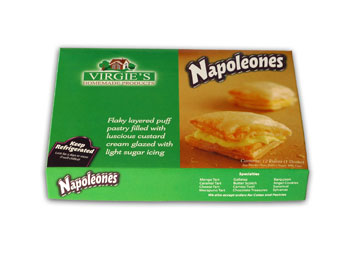
Napoleones
8:38 PM |
This product was introduced in the late 90's and has become one of our bestsellers. If you plan to give it as a pasalubong, just make sure to have your Napoleones refrigerated or chilled to extend its shelf life.
We only bake enough quantities for a day, so it's a nice idea to call us and pick it up so you can have one freshly baked.
Ingreditents: Flour, Butter, Confectioner’s Sugar, Sugar, Eggs, Milk.
Shelf Life: Lasts five (5) days if chilled.


Variants
- Assorted tarts (mango, caramel,
- cheese, pastillas de manga,
- pineapple, macapuno, langka)
- Pineapple empanaditas
- Galletas
- Special biscocho
- Piaya
- Pinasugbo
- Barquillos
- Barqueron
- Sugar twist
- Cinnamon twist
- Napoleones
- Chocolate treasures
- Butterscotch
- Food for the gods
- Camias twirl
- Cakes and other pastries
SOURCE:
Virgie’s Homemade Products
59 San Sebastian Street
Bacolod City, Negros Occidental,
Philippines 6100
Telephone
+63(34) 434-1788
+63(34) 434-1588
TeleFax
+63(34) 434-6188
Website: www.virgieshomemade.com
Email: virgieshomemade@yahoo.com
Kundol Candy by Sweet Candies
7:36 PM |
San Jose Multi-Purpose Cooperative
The cooperative started on July 2,1992 with a very small sari-sari store. It was organized by a group of farmers in the barangay who were watching over the garlic plantation of the barangay. the farmers were given incentives in the form of the products. Because of this, they were able to generate funds out of the garlic which they sold in the amount of Php. 5,000.00 which served as the initial share capital of 40 members or Php. 120 share capital per member. The San Jose Multi-purpose Cooperative was registered with the Cooperative Development Authority through the help of the Department of Agriculture on October 8, 1992 with REGISTRATION NUMBER DAG-2285.
The store became bigger with the help of Gov. Rodolfo C. Farinas who gave a grant of Php. 5,000.00. Year 2000, the small capital became big and the store concreted because of the unity of the members and good management of the officers. Php. 50,000.00 was given by DOLE as a grant used to build a processing building for the Candy Making project. The start-up capital was given by DSWD. Grant also was given by the Dept. of Trade and Industry to the Loom Weaving Industry and Binakol Craft amounting to Php. 20,000.00.
SOURCE:
SWEET CANDIES
Brgy 20, San Jose, Sarrat,
Ilocos Norte, Philippines
Mobile #: +639083873365
Email: tarigaermerlyn@yahoo.com
Crispy Dilis (Anchovies)
6:34 PM |
Ingredients: Dried Anchovies(Fish), Sugar , Coconut Oil, Spices , Chili, FD&C Yellow no. 5&6 and MSG
Net Wt: 40g (1.41oz)
QTY Per Box: 40g x 37
Packaging : Aluminum foil pouch (food grade)
Shelf Life: 1 year
Toscano’s Seakid (brand name) crispy dilis and pusit are processed from dried anchovies and squid harvested from Palawan. The products are packed in stand up aluminum pouches (25g) and are marketed locally and for export.
Crispy dilis and pusit are good as snacks, appetizers, and can also be used as toppings.
Toscano Food Industry, a company dedicated in manufacturing only high quality seafood snack products in terms of the raw materials input ,ingredients, physical appearance, packaging and taste through innovative techniques, time and our trademark recipes for the satisfaction and delight of our customers in both local and export market.
Ready To Eat Seafood Snacks
- Seakid Crispy Dilis (Anchovies) Regular, Cooked as Teriyaki Style
- Seakid Crispy Dilis (Anchovies) Spicy, Cooked as Teriyaki Style
- Seakid Crispy Pusit (Squid) Regular, Cooked as Teriyaki Style
- Seakid Crispy Pusit ( Squid) Spicy , Cooked as Teriyaki Style
- Seakid Mixed Dilis (Acnhovies) & Pusit(Squid) , Cooked as Teriyaki Style
Dried Seafood Products
- Dried Anchovies
- Dried Squid
- Tuyo
- Dried Alamang
- Danggit
- Dried Sapsap
SOURCE:
Toscano Food Industry
5 Rosal St., Merville, Tanza,
Navotas, Metro Manila, Philippines
Telephone: (632) 281-5848
Fax: (632) 871-8066/283-6167
Email: seakid@gmail.com
Mango Bars and Biscocho
7:44 AM |
The products’ shelf life ranges from 9 months to 2 years.
Trappist Monastic Food Products is a religious, non-profit organization that has been in the business of processing locally abundant fruits for 20 years.
Located in Guimaras (Region VI), Trappist produces jams, marmalades, concentrates, and other dried products from the island's abundant supply of fruits and nuts. It is BFAD-registered and complies with GMP and other food safety requirements.
The establishment employs about 25 people. Its production capacity runs to about 1,000 to 25,000 packs/bottles per product per month. Trappist products are available in supermarkets, groceries, and “pasalubong” centers in various areas in the country.
Product Lines / Variants
- Dried mango
- Dried pineapple
- Guava jelly
- Calamansi marmalade
- Calamansi concentrate
- Calamansi jelly
- Mango jam
- Pineapple jam
- Pineapple juice concentrate
- Mango juice concentrate
- Piaya
SOURCE:
Trappist Monastic Food Products
Our Lady of the Philippines
Abbey
San Miguel, Jordan, Guimaras
Mobile: +639189146240
Delisha's Homemade Atchara
9:06 PM |


Prior to 2006, Imang Conchings regularly makes atchara using various ingredients that has become a regular family fare as appetizer especially during big reunions. Even with the encouragement of family and friends, she had not made any efforts to commercialize the pickles and instead taught the recipe to her daughter-in-law for to commercialize the pickles so everyone can have a taste of her delicious pickled recipe.
In 2006, Flordiliza T. Valerio-Maglalang established FVM Foods to start the process of introducing the various atchara recipes of Imang Conching. She started sourcing supplies ensuring that such would provide the quality requirements of the products according to the instructions of Imang Conching. Flordiliza started to make 5 different pickle products as their major ingredients namely: a) young papaya, b) ampalaya, c) singkamas, d) talong and e) sili. Suggestions and comments from friends and new converts to the delicious and appetizing pickle products gave birth to its slogan “PAMPAGANA NA! MASUSTANSYA NA! ULAM PA! (It’s Appetizing! It’s Nutricious! It can be a Main Dish!).
The pickles are made from only the freshest ingredients with no added preservative. From its humble beginnings in June 2006, where it is initially distributed in Sta. Rosa, Laguna, Delisha’s Homemade Atchara is now available in various outlets in Metro Manila, Laguna, Cavite and Batangas. It has become ideal for giveaways and a special occasions and has started to be a regular gift for and by returning Filipinos. Plans are on going to export the products in the United States.
SOURCE:
DELISHA’S HOMEMADE ATCHARA
Address: Bangkal, Makati City, Metro Manila, Philippines
E-mail Address: delishas2006@yahoo.com
Contact number: (+632) 239-0570 or (0918)6470072
Gustazo Pomodoro Tinapa
8:48 PM |
Scrumptious smoked mackerel mixed with tomatoes and filled with oil. The smoky aroma with the salty, sweet and tangy flavor comes together leaving you wanting for more.

Product Lineup
- Gustazo Gourmet Tuyo in Mild
- Gustazo Chunky Bagoong
- Gustazo Gourmet Tuyo in Hot
- Pomodoro Tinapa
SOURCE:
#27 12th Avenue, Bgy. Socorro, Cubao, 1109 Quezon City, Philippines
Phone: (632) 9136998
Tinubong
8:01 PM |
Tinubong, as a delicacy, derives its name from its container, an internode of buho (bulo in Ilocano) with the node at one end, which is called tubong in Ilocano.
With the other end of the tubong open, a wet mixture of glutinous flour, sugar, coconut milk, small strips of young coconut flesh, cheese and margarine is inserted into the tube. Others also used ground peanuts and raisins.
In the good old days, the tinubong was cooked over charcoal embers until the tubong changed its color from green to a slightly scorched black. Nowadays, however, large-scale tinubong makers use the kind of ovens found in bakeries.
Arrowroot (Uraro) Cookies
5:43 PM |
Made of arrowroot flour, butter, sugar and eggs.
One of the famous Arrowroot cookie in the country is the Rejano's Arrowroot Cookies from Sta. Cruz, Marinduque
Photo: Bonggaba.com
Taho
8:54 PM |
Tahô is a Philippine snack food made of fresh soft/silken tofu, arnibal (brown sugar and vanilla syrup), and pearl sago (similar to pearl tapioca). This staple comfort food is a signature sweet and can be found all over the country.
Sisig
8:21 PM |
Sisig is a Kapampangan term which means "to snack on something sour". It usually refers to fruits, often unripe or half-ripe, sometimes dipped in salt and vinegar. It also refers to a method of preparing fish and meat, especially pork, which is marinated in a sour liquid such as lemon juice or vinegar, then seasoned with salt, pepper and other spices.
Sisig also refers to Sizzling sisig, a Filipino dish made from parts of pig’s head and liver, usually seasoned with kalamansi and chili peppers.
Chocnut King
4:50 PM |
Chocnut is a combination of ground peanuts, coconut milk, sugar and cocoa. So, definitely chocnut is a chocolate bar. Unlike any other chocolate in the world, King's Choc Nut does not melt easily when exposed to heat or it doesn't harden when left inside of a fridge. This component might be because of the presence of coconut milk.
SOURCE: NEW UNITY SWEETS MFG. CORP.
Hany Milk Chocolate
3:47 PM |
SOURCE: ANNIE CANDY MANUFACTURING
Bialon's Piaya
6:54 AM |
Piaya is a flat unleavened bread filled with mozcovado (raw) sugar. An original product of the Negros provinces, the sugar capital of the Philippines. Today, it is now also produced by other regions in the country and they come in different tastes and ingredients.
SOURCE:
Bailon’s Piaya - #17 San Sebastian Street, Bacolod City, Philippines
Telephone Numbers: + 63 (34)434-7997 | 434 7996
Patupat
6:46 AM |
Patupat, a cone shape native delicacy from Northern Luzon. It is made of glutinous rice with coconut milk, sugar and salt and wrapped in banana or coconut leaves.
Batil Patong
1:30 PM |
Batil patong is not commonly known outside of Tuguegarao in the province of Cagayan in Northern Luzon, Philippines. It is an unusual sautéed noodle dish served with dark non-soy-based sauce and with two piquant side dishes: a cup of pork broth and a dish of chopped onions, vinegar or calamansi, chili peppers, and soy sauce. The noodles are wheat-based and are served moist and chewy, topped with crushed pork-rind cracklings, and whipped egg from whence the name bati'l patong literally 'scrambled and placed on top' is derived.
SOURCE: http://www.iamnicely.com/
Halo-Halo
9:54 PM |
Source: http://blog.asiahotels.com/quench-your-thirst-with-these-asian-drinks/drinks-halohalo/
Pili Nuts
8:32 PM |
The Pili nut (Canarium ovatum), one of 600 species in the family Burseraceae, is native to the Philippines and is abundant and wild in the Bicol Region particularly in Sorsogon, and in parts of Visayas and Mindanao.

Balut
4:52 PM |
A balut is a fertilized duck (or chicken) egg with a nearly-developed embryo inside that is boiled and eaten in the shell.
Popularly believed to be an aphrodisiac and considered a high-protein, hearty snack, balut are mostly sold by street vendors in the regions where they are available. It is commonly sold as streetfood in the Philippines.
Lechon Baboy
4:49 PM |
Lechon is the Spanish name for pig, in the Philippines it means a spit-roasted pig. Lechon is prepared by stuffing the inside of the animal with herbs and vegetables. The pigs are slowly hand roasted on top of charcoal for hours till their skin turn reddish brown and the inside flesh becomes tender. The dish is often served with a thick liver sauce cooked with vinegar, sugar and herbs.
La Loma district in Quezon City praise itself as being the lechon capital of the Philippines.
Started by Mang Tomas in the early 50′s his business got a lot of competitors. The other top lechon makers are Mila, Pingping, Lito, Aling Nene and Nelia to name a few. The roasted pigs are displayed on the sidewalks.